Artificial intelligence is evolving so quickly that every few months a new model completely changes the conversation.
This time, it’s Claude Opus 4.8.
Anthropic has officially released its latest flagship AI model, and while the update may initially look incremental, the deeper details reveal something much bigger happening inside the AI industry.
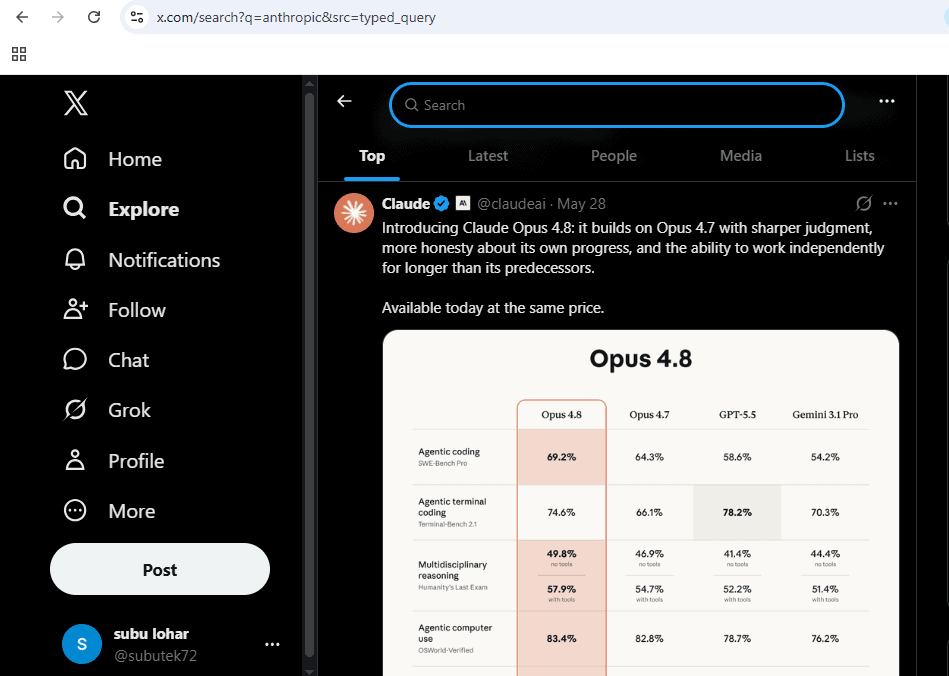
Claude Opus 4.8 is not just another chatbot upgrade.
It represents a major shift toward autonomous AI systems that can reason, execute workflows, manage long-running tasks, and operate more like digital workers rather than simple assistants.
And honestly, that may be one of the most important trends in AI right now.
What Is Claude Opus 4.8?
According to Anthropic, Claude Opus 4.8 is a “hybrid reasoning model” optimized for:
- coding
- AI agents
- enterprise workflows
- long-running tasks
- and professional knowledge work
Unlike earlier AI systems that mainly focused on answering prompts quickly, Opus 4.8 is designed to stay consistent across extremely large workflows.
One of the biggest announcements is the massive 1 million token context window.
In simple terms, this means Claude can now process and remember enormous amounts of information simultaneously.
That allows it to:
- analyze huge codebases
- handle massive documents
- maintain long conversations
- execute complex workflows
- and operate over long sessions without losing context
This is especially important for businesses and developers who need reliability across large projects.
AI Is Moving Beyond Chatbots
The most important thing to understand about Opus 4.8 is this:
The AI industry is no longer competing only on chatbot quality.
The new competition is about:
- reasoning
- autonomy
- workflow execution
- memory
- planning
- and AI agents
In other words, companies are now building systems that can actually perform work.
That is a massive shift.
Earlier AI tools mostly generated responses.
Now models like Claude Opus 4.8 are starting to:
- coordinate tasks
- launch sub-agents
- verify outputs
- plan workflows
- and continue operating independently
This is why many experts believe the future of AI is “agentic.”
Not just conversational.
Dynamic Workflows: The Biggest Feature Nobody Is Talking About
One of the most fascinating additions in Opus 4.8 is something Anthropic calls:
Dynamic Workflows
This feature allows Claude to:
- break down complex problems
- launch multiple parallel sub-agents
- coordinate long-running operations
- verify results before reporting back
Essentially, AI is starting to behave less like a chatbot and more like an operating system.
For example, Anthropic says Claude can now perform:
- large-scale code migrations
- software refactoring
- enterprise workflow coordination
- and long-duration coding operations
across hundreds of thousands of lines of code.
That’s not simple prompt generation anymore.
That’s operational execution.
Why “Honesty” Became a Major AI Feature
One of the most surprising parts of Anthropic’s announcement was the focus on honesty.
At first, that sounds strange.
Why would an AI company market “honesty” as a major upgrade?
Because modern AI systems often behave confidently even when they are uncertain.
Sometimes models:
- invent information
- overlook flaws
- pretend tasks are complete
- or generate unsupported claims
That becomes extremely dangerous when AI systems are managing:
- coding infrastructure
- cybersecurity workflows
- financial analysis
- enterprise operations
Anthropic claims Opus 4.8 is significantly better aligned and far less likely to ignore flaws in its own work.
According to the company, the model is around four times less likely than Opus 4.7 to let coding flaws pass without warning the user.
This is a very important shift.
Because as AI systems become more autonomous, trust and reliability become just as important as intelligence.
The Rise of Autonomous AI Systems
One sentence from the announcement stood out the most:
Anthropic says future AI systems will require stronger safeguards before broad public release.
That tells us something important.
Frontier AI labs are already thinking beyond traditional chatbot use cases.
They are preparing for increasingly autonomous systems.
This is why Anthropic repeatedly mentioned:
- alignment
- governance
- safety
- misuse prevention
- and cybersecurity safeguards
throughout the announcement.
And this connects directly to another major topic:
Claude Mythos.
Anthropic confirmed that Mythos-class models are currently being tested in cybersecurity environments but still require stronger safeguards before full public deployment.
That suggests the next generation of AI models may become significantly more powerful than what consumers currently use today.
Claude Opus 4.8 vs GPT-5.5 and Gemini 3.1 Pro
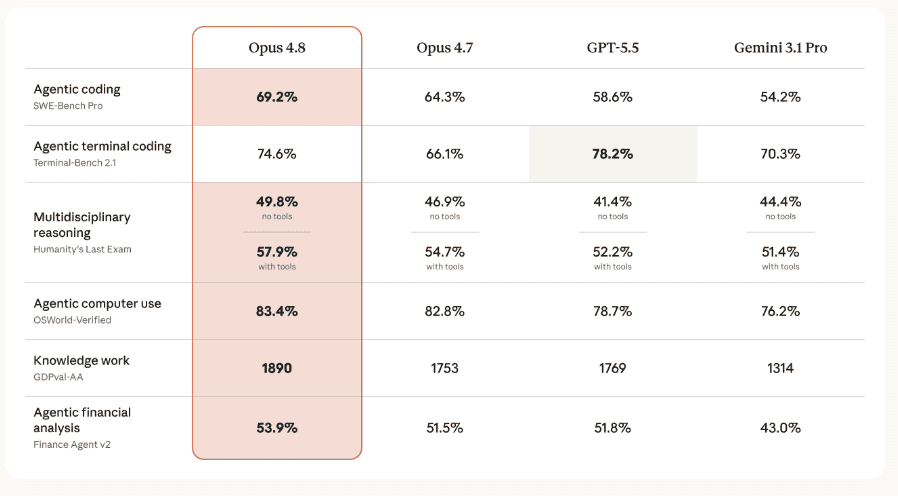
Anthropic claims Opus 4.8 outperforms:
- GPT-5.5
- Gemini 3.1 Pro
- and Opus 4.7
across several categories including:
- coding
- reasoning
- computer use
- financial analysis
- and agentic workflows
But interestingly, Anthropic is not positioning Opus 4.8 as a flashy consumer chatbot.
Instead, they are positioning it as professional AI infrastructure.
That may be the real story here.
AI Companies Are Building Digital Workers
The biggest trend behind Opus 4.8 is this:
AI companies are slowly transitioning from:
consumer AI tools…
to:
enterprise AI infrastructure.
Businesses no longer want AI that simply answers questions.
They want AI systems that:
- execute workflows
- automate operations
- coordinate software
- analyze information
- and increase productivity
In other words:
AI is moving toward digital workers.
Not just digital assistants.
And Claude Opus 4.8 feels like one of the clearest examples of that transition.
Effort Control Makes AI Feel More Human
Anthropic also introduced a feature called:
Effort Control
Users can now decide how much reasoning Claude should use for a task.
That means:
- lower effort for faster responses
- higher effort for deeper thinking
- maximum effort for complex workflows
This is actually a very smart direction for AI systems.
Because not every task needs maximum intelligence.
Sometimes users prioritize:
- speed
- efficiency
- and low cost
Other times they need:
- deep analysis
- advanced reasoning
- and high accuracy
This makes AI feel much more adaptive and collaborative.
Why This Matters for Businesses and Developers
Claude Opus 4.8 is not just another AI release.
It signals where the industry is heading next.
Businesses are now racing to integrate AI into:
- coding workflows
- enterprise systems
- automation pipelines
- customer operations
- and internal productivity systems
That creates enormous opportunities for:
- AI consultants
- automation agencies
- developers
- workflow designers
- AI infrastructure startups
- and enterprise AI specialists
Because most businesses still don’t understand how to deploy AI safely and effectively.
And that knowledge gap is becoming valuable very quickly.
Watch Video to know More Details:
Final Thoughts
Anthropic described Opus 4.8 as a “modest but tangible improvement.”
But honestly, even small improvements at the frontier level can create massive capability shifts.
Claude Opus 4.8 is not just about smarter conversations.
It’s about:
- smarter execution
- better reasoning
- autonomous workflows
- and reliable digital work systems
And that may define the next era of artificial intelligence.
Because the future of AI may not belong to the best chatbot.
It may belong to the AI systems that can actually perform work.
And Claude Opus 4.8 feels like another major step toward that future.
Source: Official Claude Opus 4.8 announcement




Share Your Views: