Web streaming content has been quite synonymous with YouTube, Netflix, and Amazon Prime amongst the millennials! But do you know what exactly streaming is and how it works?
Process of Streaming
When you use Spotify, Amazon, or maybe Netflix, it does not download the media you are watching instantly! Rather, it downloads it side by side in real-time as you binge-watch your favourite episode of GOT!
‘Streaming’ in itself is a self-descriptive word. Just like you fill a water bottle under a steady stream of water from a tap, likewise, streaming of content happens, bit by bit. A steady stream of information/data is downloaded as you watch it, which is the exact reason your favourite show abruptly ends or comes to a pause when your mom switches off the data or Wi-Fi! Although an exceptionally fast internet connection may download the entire stream, which sometimes goes on till the end, even if the internet is then cut off. Some services, like that of Spotify, even create small cache files on your phone or system so that future playback is smoother and faster than before.
The Sudden Boom of Streaming!
Gone are the days when you would sit in front of YouTube for hours only to see the continuous non-stop ring of buffering! It was annoying then, now things have changed, faster 4G and 5G internet networks have made streaming very convenient. Companies like Netflix and YouTube have also worked hard to change their infrastructure to support faster streaming of content.
How does it work?
Earlier, these companies would use only one or two servers to host their content, which obviously did not work. The users who were far away from these servers experienced immense lag and frustration. Things got even worse on high-traffic days like Saturday nights! These companies then created a content delivery network, known as CDN, which would store and send content. CDN is a global network of dense servers that contains the same data throughout. It helps in uniformly distributing content on time, reduces lag, and keeps the server from overloading.
Although CDN helps, streaming services and Internet service providers have again realized, with millions of people streaming the new season of Stranger Things and not to forget services like Netflix using more than 15 per cent of global internet bandwidth, the internet no matter how fast can still come to a halt!
In such a crisis, OCAs, also known as Open Connect Appliances, are provided by streaming services to ISPs. These are hard drives full of popular songs, games, movies, and streamable content, which reduces the need to redirect you to Netflix or Amazon server and directly provides you the stream without lag and also controls the web traffic.
With such complexities being solved and streaming becoming a daily routine, gamers from all over the world are taking over the internet to showcase their skills and make way for another source of employment, contributing hugely to the GDP and pride of each nation. For those who have taken a weekend for themselves, cheers, it is 2026, and streaming is butter smooth, you can lie back on Netflix and chill!
Conclusion
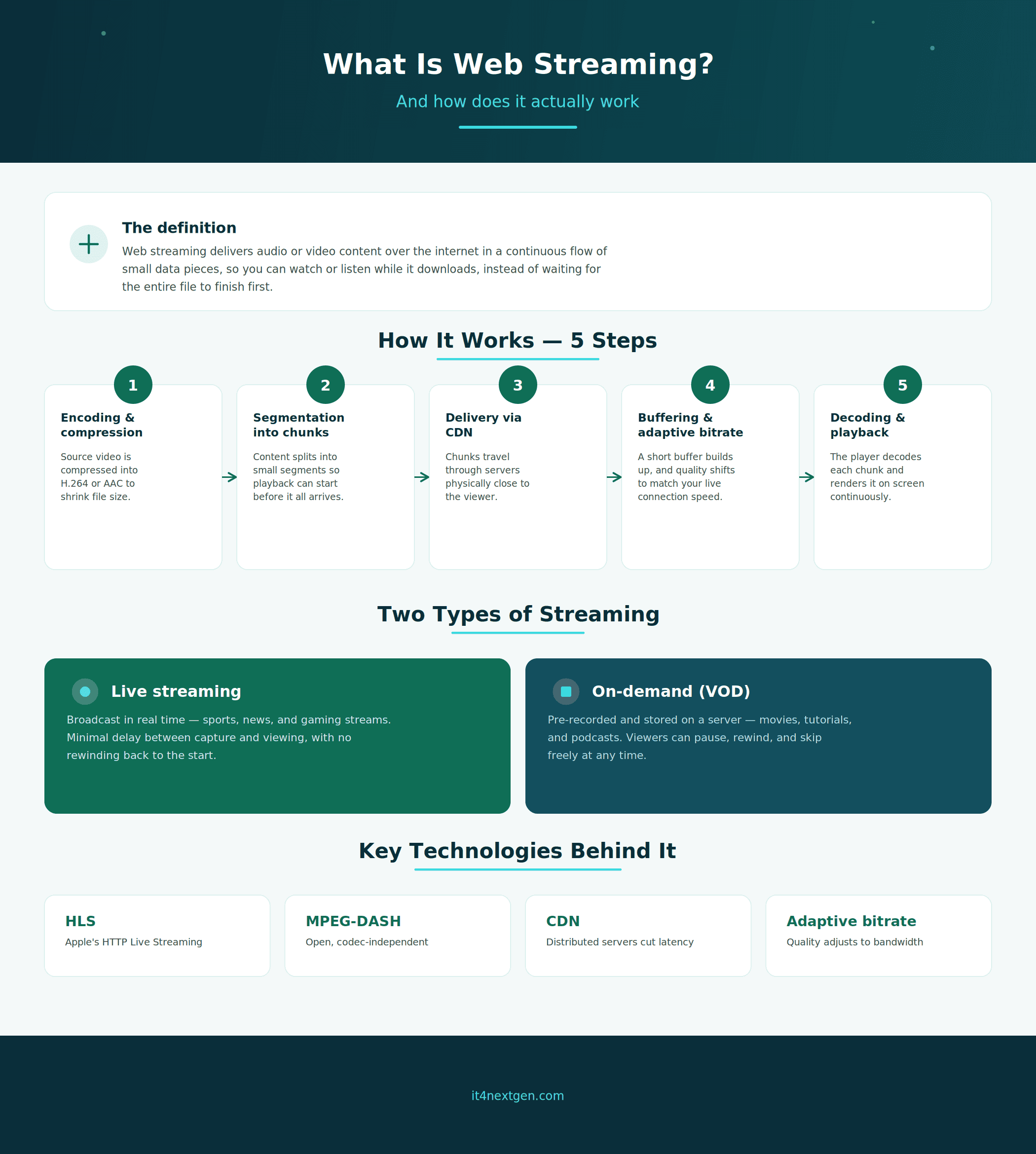
Web streaming has quietly become the backbone of how we consume media today — from live sports and news to on-demand shows, music, and tutorials. At its core, it’s a simple idea: break content into small pieces, send them continuously, and let your device play them as they arrive instead of waiting for a full download. But behind that simplicity sits a coordinated system of encoding, segmentation, CDNs, and adaptive bitrate technology all working together to make sure playback stays smooth, no matter your device or connection speed.
Whether you’re building a streaming platform, troubleshooting buffering issues, or just curious about what happens when you hit “play,” understanding these fundamentals makes the technology a lot less mysterious — and a lot easier to appreciate every time a video loads instantly.


Share Your Views: